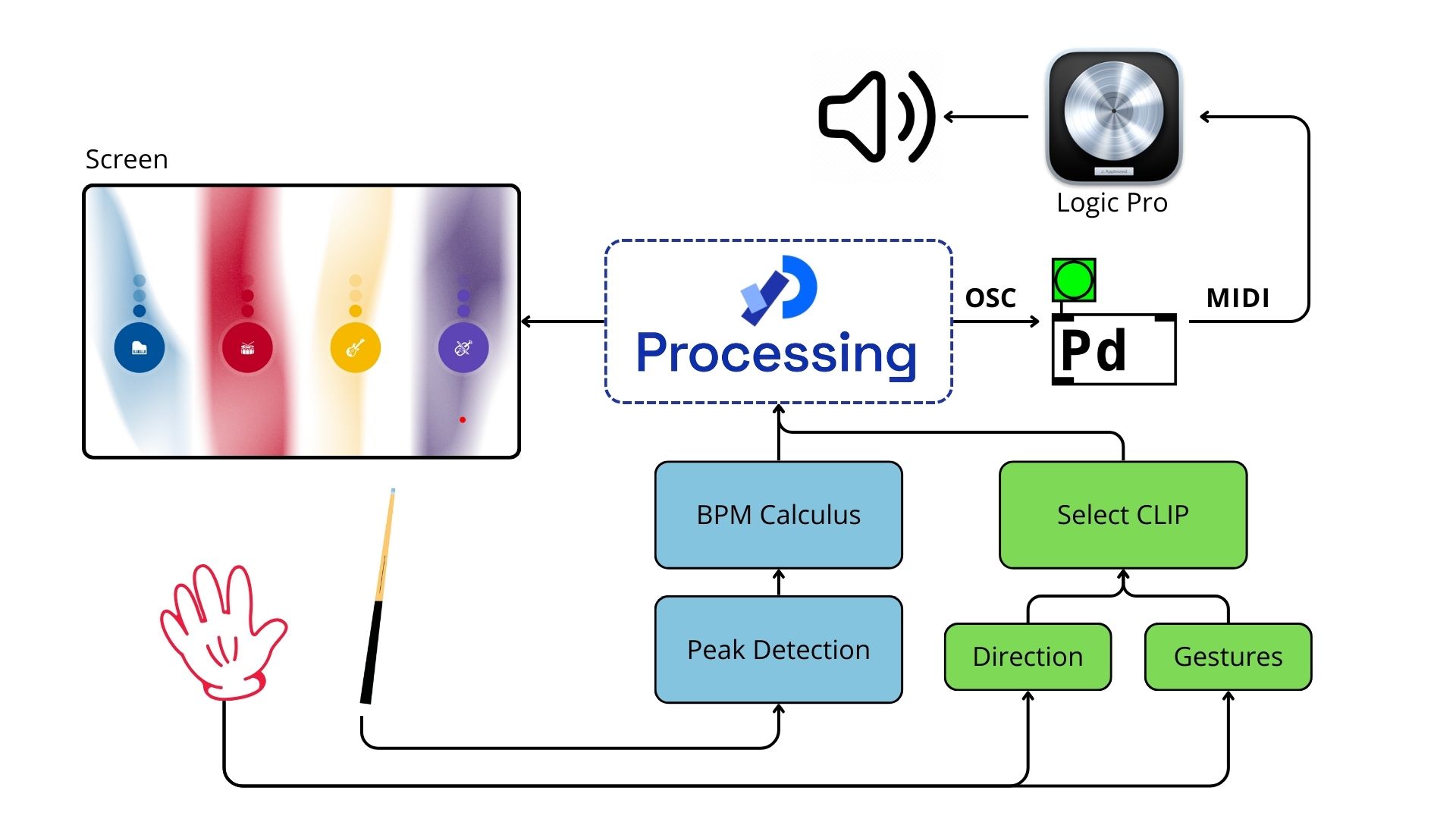
System architecture diagram showing the connections between hardware and software components.
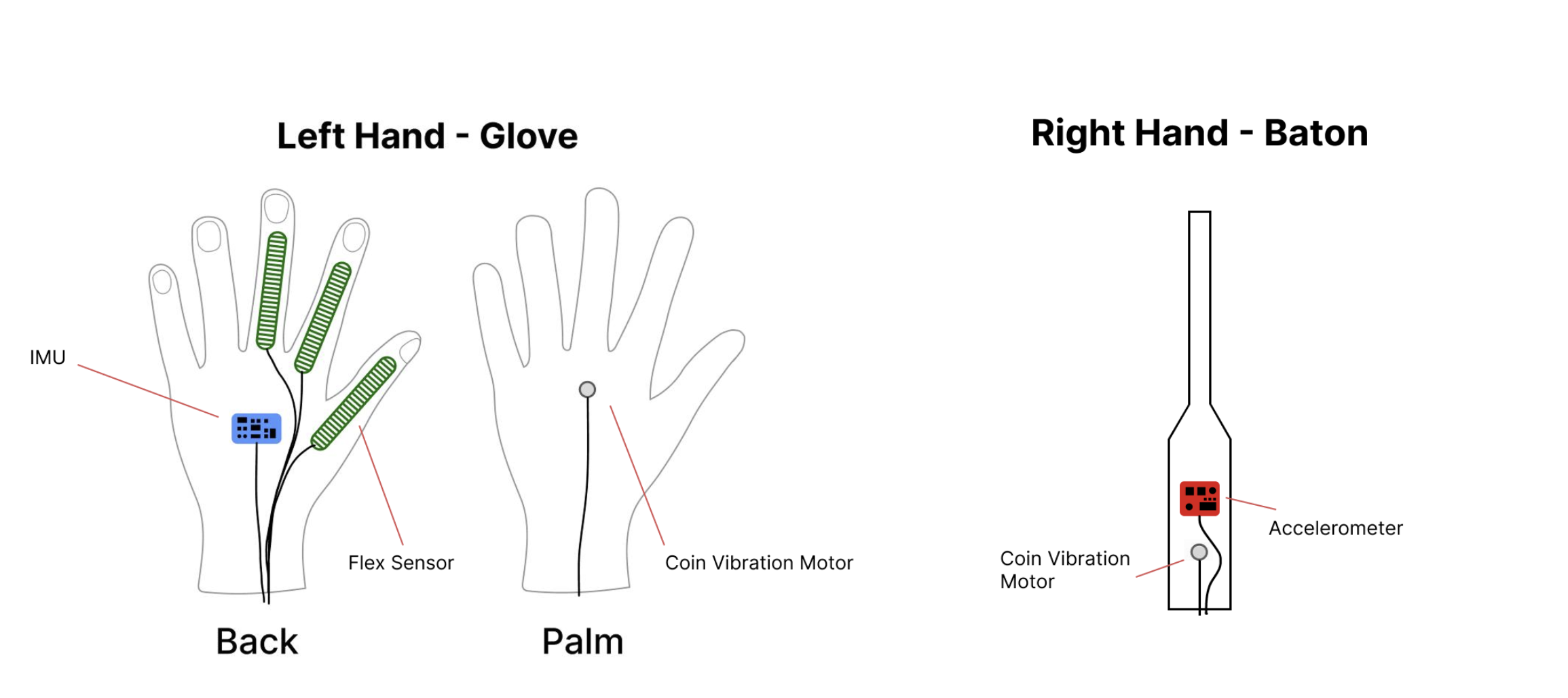
Sketch of the glove and baton controllers design.
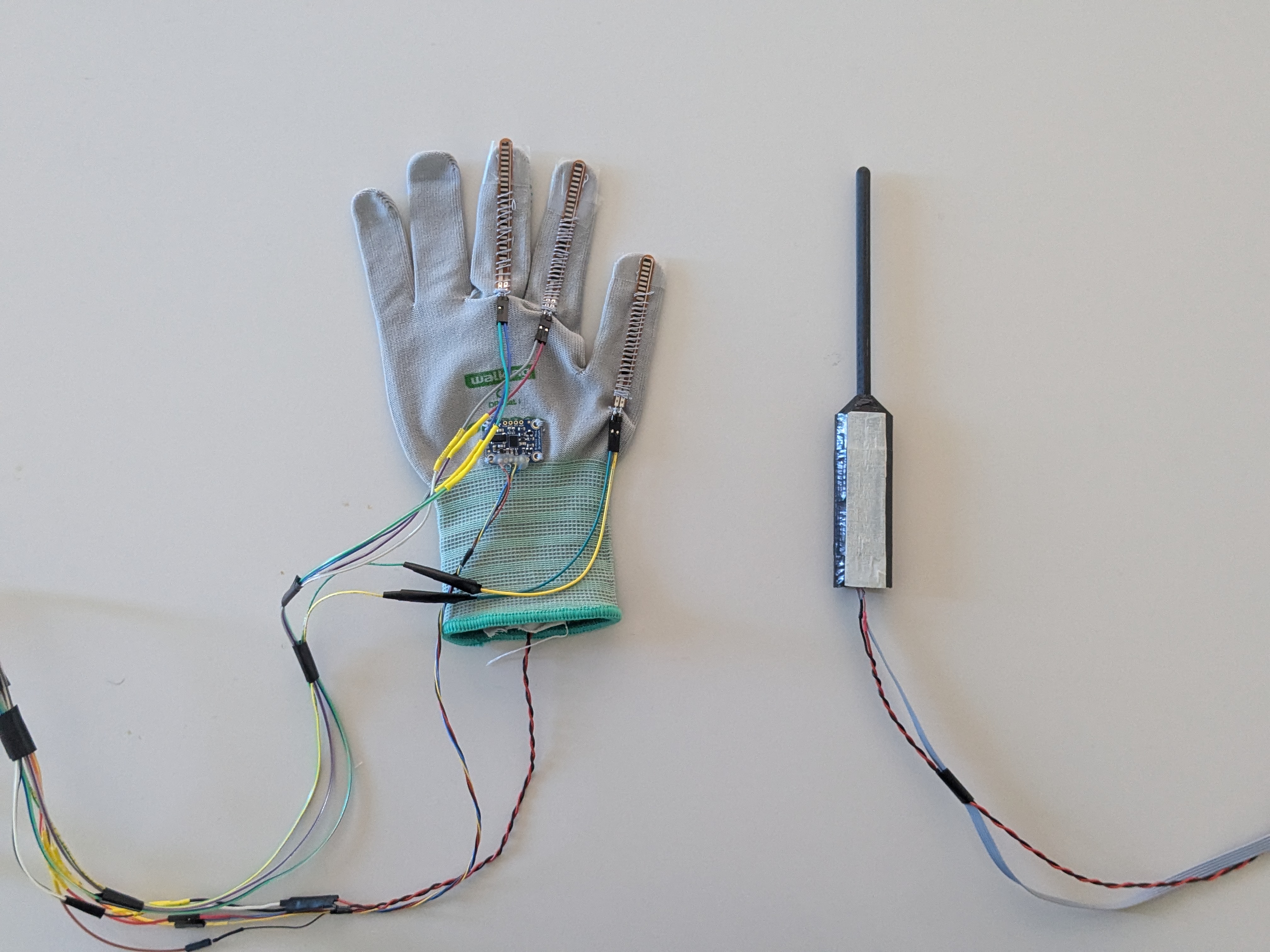
The actual implemented controllers in use.
Maestro is an experimental project exploring a futuristic way to make music through gestural control and haptic feedback. Inspired by orchestra conductors, Maestro lets users control musical loops through gestures and receive haptic feedback — gentle vibrations that make the experience more tactile and intuitive. The system is designed for anyone, even if they've never played an instrument before. All you need is rhythm and curiosity!
The system consists of a glove with flex sensors, an IMU, and a vibration motor, paired with a baton containing an accelerometer for beat tracking. The goal is to investigate whether adding haptics improves the playability and overall feel of this kind of "air instrument" for music creation.
The system is made up of:
When you wear the glove and pick up the baton:
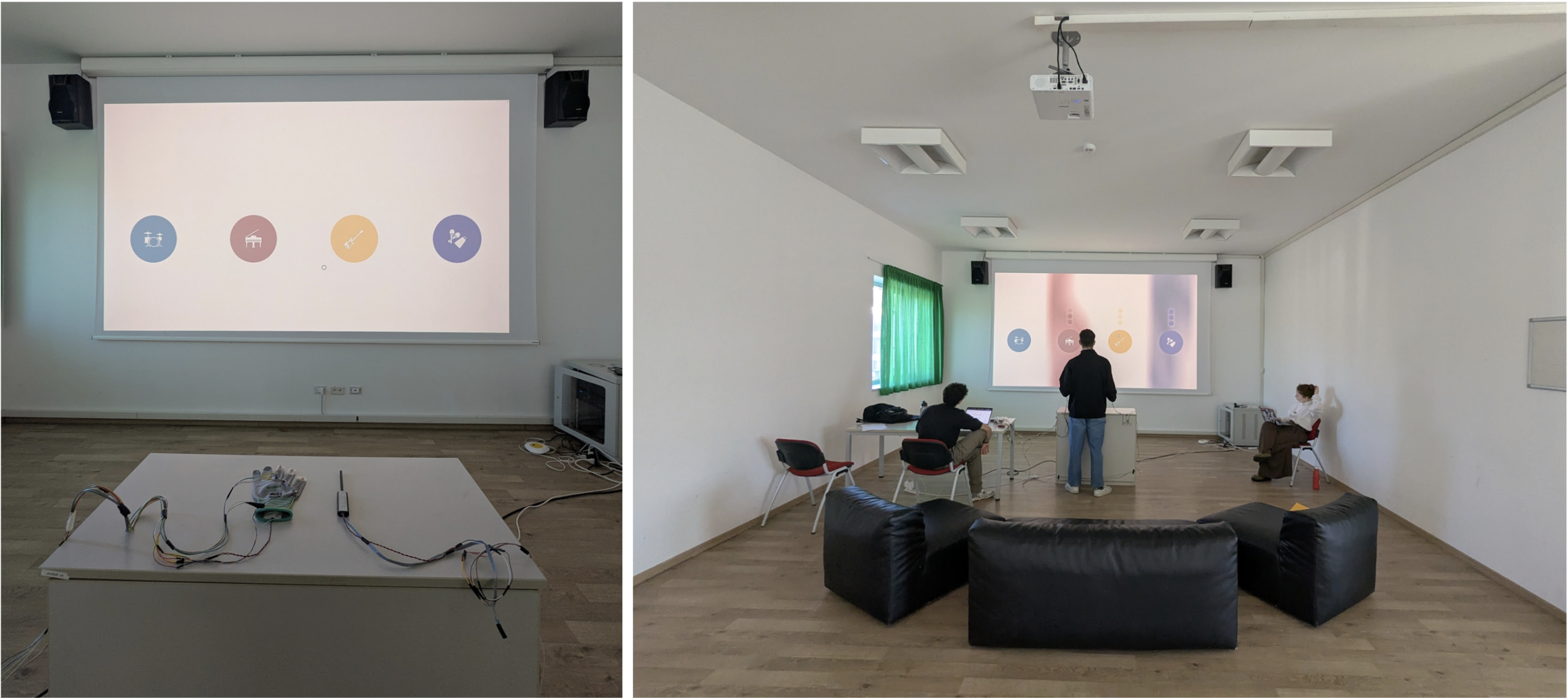
A projected interface helps guide your movements, with four musical tracks (like drums 🥁, bass 🎸, synth 🎹, etc.) and three levels of complexity.
We ran tests with 18 participants — musicians and total beginners alike. They played with and without haptic feedback, and we compared:
Results: The glove was a hit with haptics — people found it easier to use and more satisfying. The baton still has room to grow (timing control was tricky), but overall, the feedback made the experience feel more immersive.
@misc{decarlo2023maestro,
  title={Maestro: Conduct Music with Your Hands! Testing Haptics for Primary Feedback in a Music-Making Multisensory Interactive System},
  author={De Carlo, Andrea and Tangerini, Gabriele and Di Bari, Lucrezia and Cau, Pietro},
  year={2023},
  institution={University of Trento},
  type={Course Project},
  note={Multisensory Interaction Systems}
}