LeMur Scheduler: An Innovative Approach to Spiral Binding Planning

University of Trento
🏆 Winner of the Industrial AI Challenge 2025

🌀 Team 3 - LeMur's mission: revolutionize the way LeMur schedules production in its spiral binding department through intelligent automation and optimization

🔍 The Challenge

Efficient workforce scheduling and workload management are critical for any modern manufacturing process. LeMur sought a system that could generate optimized production plans, balancing workload distribution while respecting the unique constraints of their spiral binding operations—where manual interventions and asynchronous machine operations add complexity.

Our team set out to design a smart scheduler capable of suggesting optimal machine and operator schedules, ensuring balanced distribution of manual tasks, and delivering scalable and flexible planning over an extended time horizon—going beyond the company's current day-by-day planning approach.

🧠 Problem Definition

To build an effective solution, we first developed a deep understanding of LeMur's internal processes, defining key concepts like:

  • Articles (products)
  • Cycles (Setup, Load, Running, Unload, Machine Waiting)
  • Operators and their roles

We identified hard constraints (e.g., max simultaneous manual operations) and incorporated company-specific logic such as active/inactive cycles, partial/complete cycles, and machine capacity variations.

🛠 Methodology & Tools

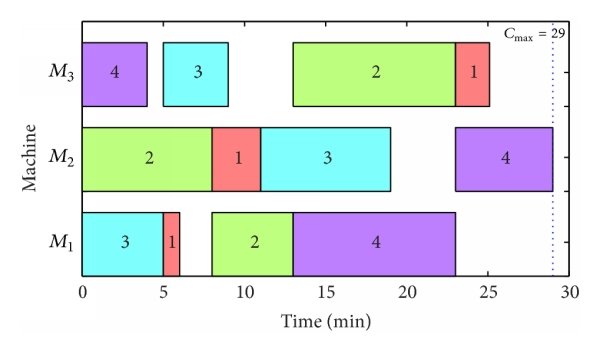
The core scheduling problem falls under the Job Shop Problem (JSP) category, which is computationally complex. We chose a hybrid approach combining:

  • Constraint Programming (for solution correctness and expressiveness)
  • 🔁 Genetic Algorithms (for refinement and computational scalability)

Tools Used:

  • Google OR-Tools for CP modeling and solving
  • Inspyred for the genetic refinement phase

3-Stage Optimization Pipeline:

  1. Makespan Minimization
  2. Compactness Maximization
  3. Genetic Refinement

✅ Results & Evaluation

Our hybrid solver delivers:

  • Valid schedules within short computation times, even on complex scenarios
  • Progressive improvements through optimization stages
  • A strong match between generated and ideal workloads, often outperforming LeMur's current planning system

⚙️ Performance Highlights

  • Quick generation of first valid solutions
  • Scalable on more powerful hardware
  • Balanced operator workloads, minimizing bottlenecks and overloads

📊 Real-world Comparison

Tests showed our scheduler better reflects actual workload realities, highlighting areas where the current planning might underestimate operational demands.

🌐 Integrations & Tools

To make the system user-friendly and practical:

  • A local web app was built for input management and Gantt chart visualization
  • A data converter was created to seamlessly interface with LeMur's current planning formats

🏭 Impact & Future Directions

The system paves the way for:

  • Higher operational efficiency
  • Better long-term planning
  • Healthier workloads and improved work environments

Proposed future enhancements include:

  • "Ghost production" suggestions based on demand forecasting
  • Energy consumption and machine speed optimization
  • Integration with LeMur's ERP for full automation

BibTeX

@misc{decarlo2025lemur,
  title={LeMur Scheduler: An Innovative Approach to Spiral Binding Planning},
  author={De Carlo, Andrea and Cazzola, Luca and Lorenzi, Alessandro and Sperandio, Luca and Cavicchini, Davide and Poiana, Emanuele and Vento Maddonni, Silvano},
  year={2025},
  institution={University of Trento},
  type={Industrial AI Challenge Project},
  note={Winner of Industrial AI Challenge 2025}
}